1/03/2010

New Year, New (ish) Books


So, I'm not a big fan of new year's resolutions, but I do figure that now is a good time to get cracking on some new and not so new books I have been putting off.

Here is my reading list so far.

The Value of Nothing: How to Reshape Market Society and Redefine Democracy by Raj Patel

Something to Tell You: A Novel by Hanif Kureishi

The Black Album by Hanif Kureishi (For old time's sake!)

Changing My Mind: Occasional Essays by Zadie Smith

Rasta and Resistance: From Marcus Garvey to Walter Rodney by Horace Campbell (really for old time's sake!!)

The Conversation: How Black Men and Women Can Build Loving, Trusting Relationships
by Hill Harper (I know, out of left field, right? After interviewing him recently, I thought I would check the book out.)

In addition, I hope to not only follow Michael Pollan's Food Rules, but also make the attempt to cook all (or most) of the recipes in Bryant Terry's Vegan Soul Kitchen this year!

Yay for me! What are your reading?

Labels:

10/06/2009

Ru Freeman on life, politics and writing

Labels:

4/20/2009

Hugo's Book Club


Venezuelan President Hugo Chavez should seriously consider starting up a book club.

From BBC News:

A book which the Venezuelan leader Hugo Chavez presented to US President Barack Obama at the Americas summit has become a bestseller in just two days.

The book, Open Veins of Latin America: Five Centuries of the Pillage of a Continent, was ranked 54,295 on the sales charts of bookseller Amazon.com.

Now, it has risen to number two.

Written by Uruguayan author Eduardo Galeano, the book looks at the impact of foreign intervention in Latin America in the past five centuries.

It covers the continent's conquest by the Spanish nearly 500 years ago right up to the present day.

President Chavez presented his American counterpart with the book, a favourite of leftists, on the sidelines of the Summit of the Americas in Trinidad on Saturday.


For real, Chavez could make a killing doing this for a living. Like Oprah Winfrey is for fabricated memoirs, Chavez could be the literary bellwether for books on radical politics. As you may recall from three years ago, he promoted Noam Chomsky's Hegemony or Survival: America's Quest for Global Dominance, which also made the top of many bestselling lists.

Here are a couple of books I would recommend for his list, both are relative to current affairs:

Managing Mexico: Economists from Nationalism to Neoliberalism by Sarah Babb

The Darker Nations: A People's History of the Third World by Vijay Prashad

You all can throw in your suggestions too!

Labels: ,

12/29/2008

GW 2008 Book of the Year


Of course a book on one of the greatest social activists of all time is going to get top honors from us! BBC presenter and author Colin Grant may have written the most comprehensive biography of radical Marcus Garvey, beginning with his roots in Jamaica to becoming a spokesman for the black diaspora. Negro with a Hat is a must read.

Over the weekend, we, the Associates, thought about what new media tools Marcus Garvey would use today if he were alive. Here are our thoughts and why:

Talia: Marcus Garvey would be a dedicated blogger. He would probably be blogging about the injustices incurred by Hurrican Katrina, the undevelopments of Africa and the continuing struggles of black people worldwide. Not only would the Field Negro have a run for his money, but Garvey's blog posts would probably have more comments than W.E.B. Dubois' blog.

Marjane: Twitter would be his tool for activism because he used to organize his mass rallies, sometimes on short notice, and he would need to contact as many attendees as possible. He would also use Google Maps to map out social injustices around the world.

Philip: Marcus Garvey would be a Facebook addict. He would easily attract thousands of Facebook friends like overnight and raise crazy money like Obama for the Black Star company.

Maria: YouTube, podcasts and Ning would be his tools. Marcus Garvey used to give powerful speeches, and viral video and audio, more people could have seen and heard him in action. I think he would have had a Ning because he believe in his supporters being their own activists, and they could have used Ning to start their own social networks.

Labels: , ,

6/10/2008

Waiting 'Til the Midnight Hour


Gill Scott-Heron once said “the revolution will not be televised” – so Peniel E. Joseph wrote about it instead. In his provocative book, “Waiting ‘Til The Midnight Hour: A Narrative History of Black Power in America,” the young Brandeis University professor/social activist chronicles the highlights and lowlights of the people and the ideas that made up organized black radicalism in the United States over the last century. While the seeds of black power bore their roots in Marcus Garvey’s United Negro Improvement Association, the book really takes off during the burgeoning civil rights movement in the 1960s, when black militants like Stokley Carmichael and Malcolm X began to question Dr. Martin Luther King’s peaceful resistance tactics to address racism. Joseph does a good job of giving comprehensive biographies of not only the well-known key players like Amiri Baraka, James Baldwin and Angela Davis, the author also pays homage to long-forgotten names, such as renegade journalist William Worthy who befriended Communist leaders in Viet Nam and Cuba during the height of Sen. Joe McCarthy’s witch trials. Joseph also points out the failures of some black power groups, most notably the Black Panthers, the militant, Oakland-based cadre that fell from national prominence due to internal conflicts and the vices of the Party’s leadership (Huey Newton’s drug addiction and Eldridge Cleaver’s misogyny and conversion to conservatism).

The black power movement left an indelible mark in American history, as can be seen in today’s social movements and particularly the rise of hip hop in the 1980s. The black power movement also provided an opportunity for African Americans to see themselves on the international level and unite with other blacks worldwide in the name of Pan-Africanism. With the high amount of support for Sen. Barack Obama’s Presidential candidancy from the African Diaspora, its seems like black power may have come full circle. This only begs the question – what would Marcus Garvey have thought of Obama if he lived today?

Labels:

3/09/2008

Spring Forward Into Books!


Here are a few books I will be reviewing soon, so get cracking on your spring reading a little early. All are dealing with my one of my favorite issues - food politics!

Bananas: How the United Fruit Company Shaped the World by Peter Chapman

Banana: The Fate of the Fruit that Changed the World by Dan Koeppel

The Fortune Cookie Chronicles: Adventures in the World of Chinese Food by Jennifer 8Lee

Labels:

11/14/2006

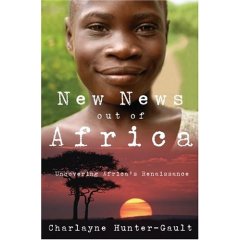
Book Review: New News Out of Africa

Veteran journalist Charlayne Hunter-Gault hits the nail on journalism's head with her latest book, New News Out of Africa: Uncovering Africa's Renaissance. Hunter-Gault, who up until recently was the Johannesburg Bureau Chief for CNN, gives her take on media coverage of Africa. Half of the book is dedicated to her work experience in both pre- and post-apartheid South Africa, while the other half examines what she calls the renaissance occurring in postcolonial Africa with the help of enterprising African journalists. If one only depended on Western media for news about the continent, they would conclude that the only things happening in Africa are war, famine and HIV/AIDS. This Afro-pessimism is further compounded by patronizing celebrities and Live 8 concerts that claim to be "saving" Africa. While she agrees that atrocities, such as the HIV/AIDS pandemic and the Darfur genocide should be covered, Hunter-Gault feels that this should be balanced out with the new news about the politicians, activists and ordinary people making a positive impact on the atrocities against the odds. "Recalling the old/bad news and putting it in context must also be a part of our new news mission if there is to be any hope of the past instructing the future," she says. Hunter-Gault cites the rise in democratic elections, and, thus, more democratic leaders around the continent as part of the new news. The reporter also recognizes being an African American and a woman has also helped her to "come in right" or fairly report news about Africa. A must read for all journalism students and those who care about Africa's future.

Labels: